EarthNet MPLS VPN Solutions
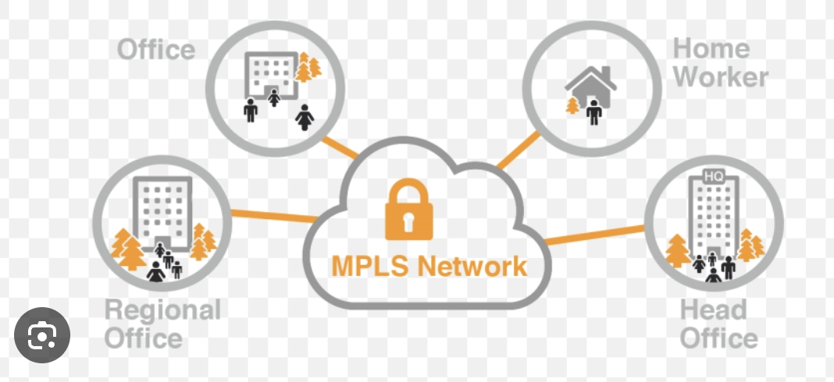
MPLS VPN is a high-performance, scalable private network architecture based on the operator's core network. It uses MPLS technology to build a logically isolated private network for enterprises on the public IP infrastructure, providing security and quality of service (QoS) similar to traditional dedicated lines, while having the flexibility and cost-effectiveness of IP networks.
Key advantages
Business isolation:
Multi-tenant security isolation is achieved through VRF and MPLS labels without encryption.
Any-to-any connection:
Supports flexible topologies such as FuI-Mesh and Hub-Spoke to simplify enterprise networking.
Service quality assurance:
Differentiated services (DiffServ) are implemented based on EXP bits to ensure low latency for key services.
Scalability:
The core network does not need to be aware of customer routes and supports large-scale VPN deployment
Converged bearer:
Unified bearer of IP, voice, video and cloud services to reduce TCO.
Core Features:
VRF (Virtual Routing and Forwarding): Each VPN customer has an independent routing table to achieve logical isolation.
MP-BGP (Multi-protocol BGP): Used to exchange VPN routing information between PEs (Carrier Edge Routers).
Double-layer label:
Outer label (Transport Label): Used for internal forwarding in the MPLS network (assigned by LDP/RSVP-TE).
Inner label (VPN Label): Identifies the target VPN (assigned by MP-BGP).
Arbitrary interconnection: Supports multiple networking modes such as Full-Mesh and Hub-Spoke.
Typical applications:
Enterprise private network (interconnection between branches across regions)
Financial/government secure communications (data isolation to avoid leakage)
Cloud access (enterprises connect to public cloud resources)